Financial Literacy: Shopping

One of the major components of our school’s mathematics curriculum is our spring financial literacy unit.  The reason we focus on this for so long is that for our students to become successful independent adults they need to be able to use money effectively in the community.  The three components of our financial literacy unit are shopping, banking, and budgeting.

Our students have learning and developmental disabilities that impact how they relate to the outside world.  It is often hard for our students to transfer what we teach in class for use in the community.  Students who seem to have mastered a skill in class may not be able to demonstrate this mastery when needed in the community.  The theory and problems with the transfer of learning have been well documented (here and here).  This is why we go out into the community as part of our financial literacy unit.  We want to see what the students can do when faced with using these mathematical skills in the “real world.”

I have written in the past about how we are integrating MathTwitterBlogosphere (#MTBoS) resources for our financial literacy unit.

Thanks Graham, what a good idea!

This will be the first in a series of posts about our financial literacy unit.  The focus of this post will be shopping.
Continue reading

On Access and Equity

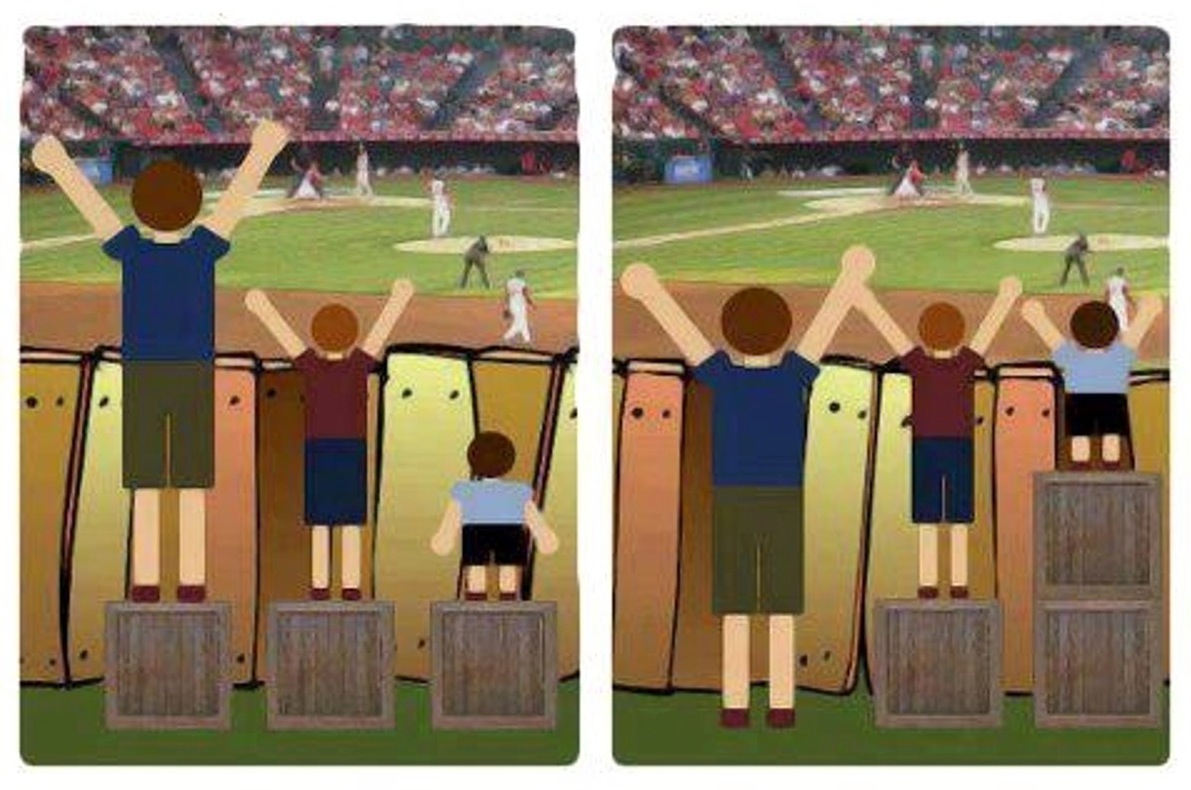
At the annual meeting and exposition of the National Council of Teachers of Mathematics (NCTM), a major theme was the access and equity of high quality mathematics instruction for all students in the United States.  This included race, ethnicity, gender, socioeconomic status, ESL/ELL students and students who were often referred to as “struggling in math.”  Very rarely was the access and equity of high quality mathematics instruction for students with disabilities discussed.

Equity and equality does not look the same for everyone.

Equity and equality does not look the same for everyone

I freely admit that the equity for these other students groups must be a topic of discussion, but so does that same equity for students with disabilities.  Students with all disabilities, not just those who “struggle in math.”  If we are going to advocate for access and equity, then every student should be represented in the discussion.

NCTM’s Principles to Actions: Ensuring Mathematical Success for All describes their vision of access and equity in this way:

Our vision of access and equity requires being responsive to students’ backgrounds, experiences and knowledge when designing, implementing, and assessing the effectiveness of a mathematics program.  Acknowledging and addressing factors that contribute to differential outcomes among groups of students is critical to ensure that all students routinely have opportunities to experience high-quality mathematics instruction, learn challenging mathematics content, and receive the support necessary to be successful.  Our vision of equity and access includes both ensuring that all students attain mathematics proficiency and increasing the numbers of students from all racial, ethnic, gender, and socioeconomic groups who attain the highest levels of mathematics achievement.  (p. 60)

Students with disabilities are clearly lacking from this vision of access and equity.  Why? Students with disabilities are just as much a part of the fabric of our national education system as any other “stakeholders.”  Why have they been carefully left out of the conversation?

Continue reading

Why Count Your Money, When You Can Estimate?

The end of spring break means we are in the midst of our school’s spring financial literacy unit.  This is always a favorite of both students and teachers.  We ground our work in very concrete community related activities, such as going to the bank and going to the store.  Students love spending money and teachers love going on community walks in the spring and early summer. Everyone wins!

Before we start going on trips, I wanted to do some number sense work with my classes relating to the counting of money.  As we left for spring break I tweeted about an estimation idea inspired by counting money.

Right on cue, Graham Fletcher, who writes his own amazing blog here, gave me some sage advice.

I took Graham’s advice and ran with it.  As much as we like our money math standards to relate to identification of coins and bills and getting accurate counts on prices and change, estimation is a key skill in any “real world” financial transaction.  When was the last time you stood at the supermarket register counting out the entire pile of change you got from the cashier? Generally, we look at the coins in our hand and make a quick estimate as to whether we think it is the correct change or not.  So I used the idea from my tweet, took some inspiration from fellow math teachers Andrew Stadel and Joe Schwartz, and turned it all into a financial literacy lesson.

Here’s how it went…

Continue reading

Noticing and Wondering About Scaffolding

Often I wonder how much to explain or define for my students before engaging in the problem solving process.  Proponents of sense-making in mathematics classes like Dan Meyer and The Math Forum encourage presenting a perplexing scenario to students and letting them develop the questions to be answered using math.  This is a very enticing proposition.  Who wouldn’t want a math class which uses the Socratic method to solve problems as a community.  I do!  Professor Ilana Horn recently wrote a piece investigating the merits of this pedagogical philosophy with other popular options like Doug Lemov’s Teach Like a Champion.

Some students, however, need more scaffolding, language support, cultural background, or skill reinforcement before they are ready to grapple with a truly perplexing situation.

Vygotsky's Zone of Proximal Development

Vygotsky’s Zone of Proximal Development

For instance, what if your students view their zone of proximal development much differently than you, as the educator, do?  What if the student views every problem as lying in the outer ring, but it truly lies in the middle or inner ring according to your professional opinion?  Which leads into my question about problem-based learning.  How much do you scaffold for students who need it before you set them free to make sense of a great, perplexing mathematical scenario?

This is a major question for special education math teachers.  How much scaffolding is too much so that the process of solving the problem is taken out of the hands of the student?  One area where this comes up is when teachers are deciding what order in which to present information to students during the problem solving process.  As an example, here is a problem I have been developing in which there are two components.  Which of these components should go first in a truly problem-based classroom?  Maybe you can help me figure it out!

Continue reading