An Inch Wide and An Inch Deep: A Call To Action

One of the most popular ways to critically describe mathematics education in the United States is “a mile wide and an inch deep.” The TL;DR is that most mathematics education focuses on too broad an array of topics with a lack of emphasis on conceptual understanding and critical thinking.

My worry is that most special education math classes are an inch wide and an inch deep. I ran across this chart from Browder, Spooner, Ahlgrim-Delzell, Harris, Wakeman (2008).

image1

Demonstrated here is a clear focus on an extremely small amount of topics and the only one investigated in any kind of depth is financial literacy, which admittedly is an extremely important topic for students with disabilities. For students with disabilities to be successful members of their communities they need to be financially literate. But this need should not preclude students with disabilities from exploring other mathematical topics.
Continue reading

Contemplate then Calculate: Dominoes

The math department at my school is working to implement instructional routines in our classes for several reasons. The first reason is to increasingly apply the standards for mathematical practice on a daily basis. The second reason is to improve our communication as a department by creating common language centered around shared routines and activities.

One of the instructional routines we plan to implement is Contemplate then Calculate (#CthenC on twitter). Created by Amy Lucenta and Grace Kelemanik at the Boston Teacher Residency, #CthenC is a highly structured routine that simultaneously allows for open mathematical thinking and problem solving. Contemplate then Calculate highlights looking for and making use of mathematical structure in problem solving.

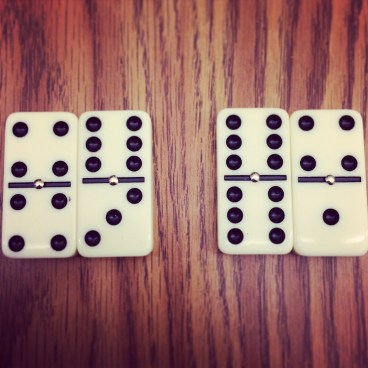
In an effort to assist the implementation of Contemplate then Calculate at our school, I created this activity to do with my class as a model for implementation and discussion.

Here is the task:

IMG_6879

How many dots?

Continue reading

Hollywood Doesn’t Understand Teaching

In 2013, Dan Meyer released a video which edited together all of the negative comments about math made in Hollywood movies. It was called Hollywood Hates Math. Recently, two television shows premiered that center their stories around the professional lives of teachers.

Here are a couple of clips:

Art class in Teachers on TV Land

Spanish, History, and Gym classes in Those Who Can’t on TruTV


Besides filling the stereotypical gender roles of elementary and high school teachers, these scenes provide a litany of examples where teachers are portrayed more as “babysitters” than professionals.

Finally, here’s a bonus clip from a show you may already be familiar with, Girl Meets World. I’ll leave you with this question, what was the lesson plan?

Reimagining Inclusion with Positive Niche Construction

Every classroom is a bustling ecosystem of voices, ideas, and inside jokes. Every member of the classroom, teachers and students, is working together to form a cohesive learning environment. Each classroom is different based on the unique members that make up its ecosystem.

The broad range of experiences and perspectives brought to school by culturally, linguistically, and ethnically diverse students offer a powerful resource for everyone to learn more—in different ways, in new environments, and with different types of people. Every single person in this enormously diverse and ever-changing system has the power to serve as an invaluable resource for all others—students, teachers, and the community as a whole. Rather than constituting a problem for students and educators, the growing diversity in U.S. classrooms necessitates and encourages the development and use of diverse teaching strategies designed to respond to each student as an individual (Saravia-Shore, 2008).

The diversity of the classroom is at the epicenter of the learning environment. Diversity, however, can come to mean a variety of things.

Recently, I have been reading about the concept of Neurodiversity. Essentially, neurodiversity is based on the idea that brain diversity is similar to cultural diversity and the diversity of ecosystems.

We don’t pathologize a calla lily by saying that it has a “petal deficit disorder.” We simply appreciate its unique beauty…Similarly, we ought not to pathologize children who have different kinds of brains and different ways of thinking and learning (Armstrong, 2012).

Continue reading

Numberless 3-acts

On Wednesday I posted a 3-act task that I planned to use in my class the next day.

Here’s how it went…

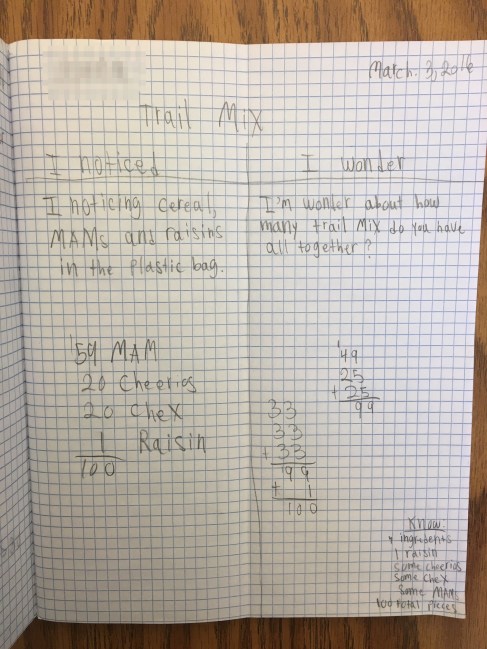
Act 1 asked students to watch a video and record what they noticed and what they wondered. As a usual modification for my students I had them make a T-chart graphic organizer in their math notebooks to record their observations. We watched the 1 minute video 4 times, twice for noticing and twice for wondering.

IMG_0784

One student’s math notebook

Students noticed:

  • The plastic bag was being filled
  • There were some cheerios
  • There were some chex
  • There were some M&Ms
  • There was 1 raisin

Students wondered:

  • How many trail mix pieces altogether?
  • Why didn’t I add more cereal?
  • Why the whole bag on M&Ms was being put in the trial mix?
  • Why only 1 raisin?
  • How many cheerios, chex, and M&Ms?

Continue reading

3-act Task: Trail Mix

Student engagement is a funny thing.

On twitter I’ve been pretty critical about using extrinsic rewards to increase student engagement.

Today was our 100th day of school (as calculated by our students!) To celebrate we made 100 piece trail mix. Our trail mix included: cheerios, chex, raisins, and M&Ms. Candy! Talk about extrinsic student engagement! Before we dove in to the rewards food, I gave my class the following problem:

We have 4 ingredients to make trail mix. How many different combinations of ingredients can we have if our trail mix only has 100 total pieces?

The students persisted through their work on this word problem, until they arrived at various solutions based on their calculations and personal taste. For instance, one student is allergic to nuts and could only eat the cheerios and raisins, so that impacted his work on the problem. The students worked diligently and happily ate the trail mix once they had arrived at a reasonable solution.

However, after class I channeled Graham Fletcher and Dan Meyer to try to make this mathematical experience a more rich one for the students. So, here is a preview of the 3-act task we will be doing tomorrow in class…

Continue reading