To Calculator, or Not To Calculator, That is a Question

When it comes to planning lessons in special education, or general education for that matter, the goal is for all students to be able to access, understand, and be able to successfully apply the content to show evidence of full understanding. The application can take many forms: performance assessments, formative assessments, summative assessments, teacher observations, etc…

But how do you get to that final assessment piece? This post is about the planning process that goes into successful lessons for all students.  Let’s begin with Universal Design for Learning (UDL). UDL is a model for planning lessons and units that creates access to the content for all students.  Here is a cartoon that embodies the philosophy of UDL.

450px-Clearing_a_pat

One major component of planning in special education math classes is prioritizing the mathematical goals and the needs of the students to access the mathematics in a lesson.  A Teaching Children Mathematics article from 2004 suggests the following steps for beginning to plan a successful math lesson for students with disabilities:
Continue reading

Humans vs. Zombies! (or How We Learned About the Coordinate Plane)

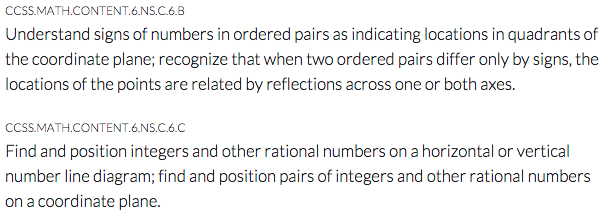
This week began our study of the coordinate plane.  I used the first lesson of Transition to Algebra’s unit 6 as a pre-assessment.  It proved that I needed to take a couple steps back and address many of the basic concepts relating to the coordinate plane (axes, integers, ordered pairs, quadrants, etc…) in a more direct way.  Our class goals are pulled from the Common Core State Standards Initiative:

Screen Shot 2015-02-03 at 8.23.00 PM

First, I used this game as an anchor for plotting ordered pairs, then the students did some individual practice on worksheets.  Today we played another game…

Humans vs. Zombies!

My very crafty assistant teacher, Ms. Avellino, took a game from a website and turned it into this… Continue reading

A Tale of Two Tasks

Differentiation is a widely accepted (and debated) strategy for meeting the needs of a diverse range of learners, especially in special education classrooms.  According to Carol Tomlinson, “a differentiated classroom provides different avenues to acquiring content, to processing or making sense of ideas, and to developing products so that each student can learn effectively.”

But what does it look like in practice?

First, let me describe our class setting to give you some background.  I teach at a self-contained special education high school in Manhattan.  The learners at our school range from students with learning disabilities or speech and language delays (which effect academic performance, but do not generally effect their physical appearance or how they react in social situations) to those with autism spectrum disorders or down syndrome (which effect socialization and communication as well as academic levels.)  Our math classes are mixed grade (9th graders with 10th graders and 11th graders with 12th graders) in order to create groupings that can best meet each student’s academic and social/emotional needs.  There are three concurrent math classes, which means our class groupings are no bigger than 8 students with a head teacher and an assistant teacher.  This leads to collaborative in-class groups that can be as small as 4 students to 1 teacher.

Continue reading

A Better Shapes Class

Christopher Danielson recently released “A Better Shapes Book” for free on his blog. Before you read on, go take a look at it, download it, and enjoy!

IMG_7237

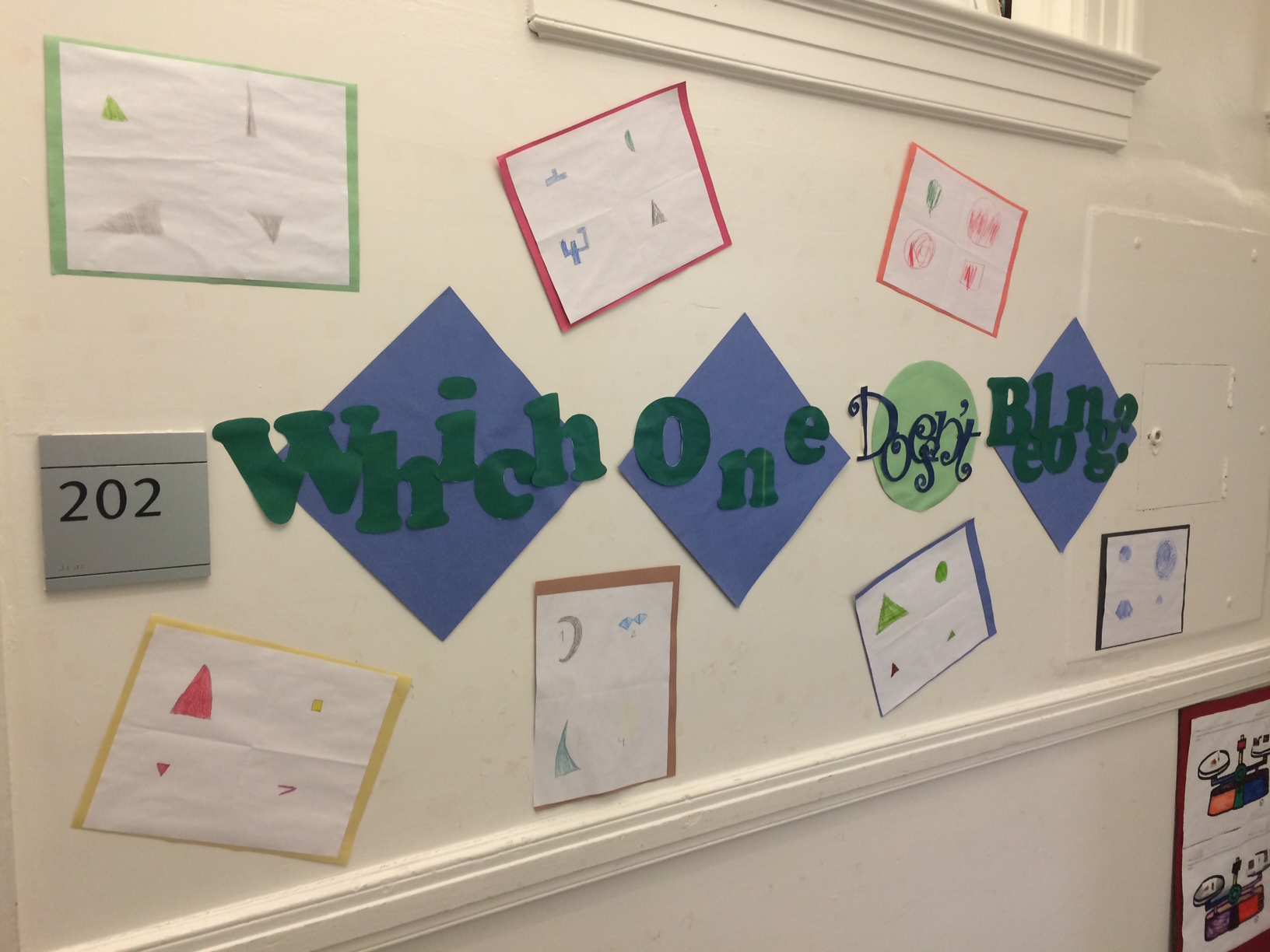
Our Hallway Display

Since some of my classes are studying geometry this trimester this was a fortuitous release.  My students, who are in self-contained special ed classes, can identify benchmark shapes (squares, rectangles, triangles and circles), but we are currently investigating how squares and rectangles relate as quadrilaterals.  This book was the best way for our students to explore shape properties without having to read, write and remember a lot of vocabulary.  We were able to discuss what they saw and critique the arguments of classmates in a safe space, because all arguments were valid for one reason or another.  The elimination of the potential to be flat out “wrong” created a safe space for my student population.  As long as there was some semblance of justification, you were “right.” The students liked that!

Continue reading

Making Math Visual

Since Differentiation is in the news, I thought it was time for us to investigate best practices in special education math classes.  And as a counterpoint to that article, here is Grant Wiggins’ response.

Differentiation is widely accepted as being at the forefront of best practices in special education.  But, when it comes to best practices in special education mathematics classrooms, not much has been clearly defined.  Here’s one take about inclusion from a Huffington Post article at the beginning of the year:

FullSizeRender

One of these “best-teaching practices” is including visual cues to accompany any words in a worksheet or presentation of information.  This idea is best represented in mathematics as mathematical models.  The What Works Clearinghouse goes into detail about the importance of incorporating visual models of mathematical concepts into lessons for struggling students.  The recommendation also illustrates how to use the concrete-representational-abstract approach in math instruction.

Continue reading

#10goodthings I’ve Learned This Year

First, I read @stoodle’s Exorcising Teacher Demons post.  In his post what stood out to me was that he took the “high road.”  Instead of actually venting for a whole blog post, which could be counter-productive, Matt chose to take his co-worker’s challenge:

If you were asked to come up with 10 things that you’re doing well this year, you could do it.

Then Meg Craig put out the call…

Here is my response to both Matt and Meg, but with a twist.  This year I have learned so much from the twitter/blog community known as #MTBoS (math twitter blogosphere) that I needed to show all of these wonderful educators just how important their impact is for educators across the country.  So, I decided to write 10 good things I’ve learned.

Continue reading

If I Could Time Travel…

If I could time travel I would do one thing.  This post is about that one thing.

tardis

Time And Relative Dimension In Space

Since everyone knows that when you travel back in time you can’t change anything because of the butterfly effect, this limits my choices to instances where I could simply be an observer.  What would I want to observe?  Would it be a famous event like the Gettysburg Address or the “I Have a Dream” speech?  Would it be something small like when my parents met or my first day of school?  No.

I decided I would want to observe myself as a first year teacher.  The reason for this comes from the advancements in technology that are making classroom filming more accessible and convenient, including this little gem.

Continue reading

We Made a Math Game!

Well, to be more precise we made a puzzle-y, game-y type thing.

Let me explain.

If you follow me on twitter, then you saw this little bit of nerdiness…

I bought this dice bonanza bucket at Target during Christmas break.  I was very motivated to put the new dice to work for my students!

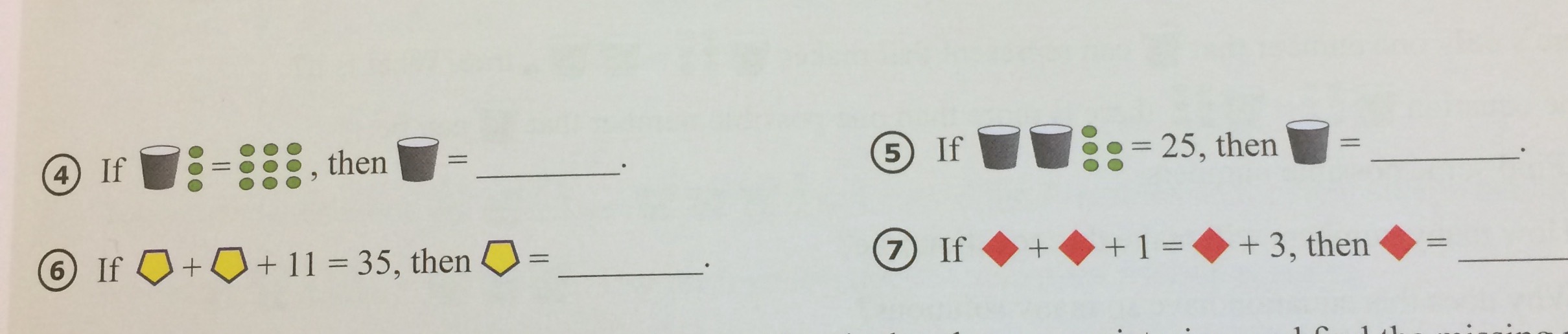
As I wrote about previously, one of my classes is studying algebra.  The contents of the dice bonanza varied between number dice, dot dice, color dice, and others it reminded me of Transition to Algebra like this:

FullSizeRender (3)

So my assistant teacher and I put the dice to work in this puzzle game we called Dice ID.  Here is the instruction booklet and here is the game board.

And here is how it went in our class last Friday…

Continue reading

Quantification

The amazing science podcast, Radiolab, recently did a show titled “Worth.”  Andrew Stadel, over at Divisble by 3, blogged about some math problems this podcast made him think of.  The podcast didn’t necessarily make me think about math problems, instead it made me consider reasoning about value and quantity.  More specifically, is everything quantifiable?

Google defines “quantify” in this way:

Screen Shot 2015-01-08 at 6.17.34 PM

Which makes me wonder can everything be expressed or measured in a quantity?  Can everything be quantified?

Radiolab gives three instances in which things are given a dollar amount that would not normally be thought of in this way.  It gives worth to things that are normally thought of as “priceless.”

Does everything have a price?

Continue reading

Algebra with a capital A!

I teach at a self-contained special education high school in SoHo in NYC.  Our math department does a good job of incorporating “algebraic thinking” into every problem we pose or task we assign.  Though, as they are in high school, our students are aware of what they “should be learning.”  In other words, they see what their peers without disabilities are doing in math class and generally it is not what they are doing.

So the desire to learn Algebra comes up quite frequently.  (The capital A is intentional in this case!)  Algebra is like our student’s white whale.  So, I try to be the boat to their Ahab.

My frustration, however, is that the typical approach to Algebra, with a capital A, is heavily language based. Vocabulary such as variable, dependent, independent, inverse, and substitute are very basic to capital A-lgebra, but they are also complex terms (and ones which have alternate meanings in everyday speech) that our students would require most of the year just committing to memory.

So I have been on a search for capital A-lgebra work that bypasses this vocabulary at least at the very beginning.  Cut to Fawn Nguyen’s Visual Patterns and Heinemann’s Transition to Algebra.

I began with a pre-assessment task about toothpicks

Continue reading