#MTBoS and the Special Education Community

On Wednesday, I presented at the New York State Association of Independent Schools (NYSAIS) Special Education Conference. My session was called “Access & Equity in Math Class for Students with Disabilities.” The goal of the presentation was to review the Standards for Mathematical Practice and pair great Instructional Routines with each one so that the special educators in attendance would be prepared to engage their students in this high level of mathematical thinking.

I made one major oversight in the planning of this session…I’ll let you guess what that was…

3338347_origYes, we could not review the Standards for Mathematical Practice (SMP), when only two of the participants had even heard of them prior to the session. Because of this, the goal of the session changed to using instructional routines to model what was meant by each of the Standards for Mathematical Practice.

Most of the instructional routines were culled from the #MTBoS. For instance, we used I Notice/I Wonder from The Math Forum to model SMP.1 – Making sense of problems and persevere in solving them, Estimation 180 to model SMP.2 – Reason abstractly and quantitatively, and Which One Doesn’t Belong? to model SMP.3 – Construct viable arguments and critique the reasoning of others.
Continue reading

Counting & Realia

OR “Why Counting Collections Should Be In the Toolkit of Every Special Education Math Teacher.”

Over the years it has become clear to me that commitment to good instructional activities (or routines) is the bedrock of any good math class, special education or not.

Magdalene Lampert defines instructional activities (or routines) as “…well designed procedures that have been proven in practice, that take into account the complexity of the goals that need to be accomplished, and that allow the practitioner temporarily to hold some things constant while working on others.  The use of such routine procedures involves not only acquiring the capacity to do the steps in the routine in an actual working environment but also the learning professional norms or “principles” that would enable a practitioner to make appropriate judgments about when and where it is appropriate to use the routines.”

This is especially enticing in a special education classroom where holding constant parts of the classroom (behavior, anxiety, comfort level with the task, familiarity of expectations, etc.) in order to highlight and work on others (mathematical proficiency) is an ideal situation for learning.

One of my favorite instructional routines is called Counting Collections.

Continue reading

Ask More Questions!

Encouraging students with disabilities to think deeply about mathematics has always been one of the goals of this blog.  But since the audience of this blog is mainly teachers, the goal is really to encourage teachers to encourage students with disabilities to think deeply about mathematics.

So here goes…Ask More Questions!

Duh! You’re thinking, “I asked 35 questions today! Numbers 1-35 on the multiplication fact fluency worksheet were math questions. This guy!”

But, the questions I’m referring to come after you ask those initial questions.  Sure, you proposed a math problem to your students or even better they proposed one to you based on some mathematical situation you presented, but then what happened?

Andrew Stadel recently wrote about and collected questioning strategies from the MathTwitterBlogosphere.  His focus was on strategies for asking questions before and after the launch of the day’s mathematical problem, task, lesson, activity, etc.  My focus has been on post-launch questioning strategies.  The stuck/unstuck questions and questions to explore student misconceptions.  In an NCTM article, which discusses warning signs of instructional moves that generally lead to taking over student thinking, the alternative teacher moves are also focused on asking questions when a student is stuck or has a misconception.

Continue reading

In Which I Give A Survey About Math To My Colleagues…

Justin Lanier gave a fun, beautiful, challenging, and useful talk at the Global Math Department on Tuesday.   His talk centered around teacher’s views of mathematics and how they can affect their student’s views.  Please take sometime to watch Justin’s presentation.  It’ll make the rest of this post make much more sense!  Or at least visit Justin’s blog where he issues a call to action.

I took Justin’s call to action and gave a google survey to my colleagues.  I sent it in an email to every staff member at my school.  This included administrators, math teachers, non-math teachers, related service providers, para-professionals, etc.  In other words EVERY staff member at my school had the opportunity to answer Justin’s question.

This is what happened…

Continue reading

Unscaffolding Math Problems

Several months ago, the new NPR show Invisibilia did a broadcast about expectations.  The main theme of the program was that the expectations others hold of an individual can effect the outcomes of that individual, either positively or negatively.  If you’d like to know more about this idea please listen to the radio show, its great!

I wanted to incorporate the show’s theme into a blog post about special education math classes, but was unsure how until Alex Overwijk, a teacher from Ottawa, sent me the following comment about my post about scaffolding

Expectations...

Expectations…

This led me to consider how the over-scaffolding of mathematical tasks and problems for special education students creates an atmosphere of lowered expectations.  Both Alex and I agreed that students with disabilities need a certain amount of scaffolding to be successful. What we didn’t know was to what degree and when this scaffolding should be provided.

Thinking more deeply about this question, I believe the degree to which scaffolding is provided to students with disabilities is a very individual, personalized process.  Great special ed teachers who understand their student’s learning pathways will be able to determine the appropriate level of scaffolding for them.  But the timing of when scaffolding is provided can show students what a teacher’s expectations are for them in math class.  If scaffolding is implemented too early in a lesson or unit, students may feel a sense of lowered expectations which according to Invisibilia would result in lowered outcomes as well.  You can’t get much earlier in a lesson or unit than the pre-assessment, so let’s start there.

Continue reading

Financial Literacy: Shopping

One of the major components of our school’s mathematics curriculum is our spring financial literacy unit.  The reason we focus on this for so long is that for our students to become successful independent adults they need to be able to use money effectively in the community.  The three components of our financial literacy unit are shopping, banking, and budgeting.

Our students have learning and developmental disabilities that impact how they relate to the outside world.  It is often hard for our students to transfer what we teach in class for use in the community.  Students who seem to have mastered a skill in class may not be able to demonstrate this mastery when needed in the community.  The theory and problems with the transfer of learning have been well documented (here and here).  This is why we go out into the community as part of our financial literacy unit.  We want to see what the students can do when faced with using these mathematical skills in the “real world.”

I have written in the past about how we are integrating MathTwitterBlogosphere (#MTBoS) resources for our financial literacy unit.

Thanks Graham, what a good idea!

This will be the first in a series of posts about our financial literacy unit.  The focus of this post will be shopping.

Continue reading

On Access and Equity

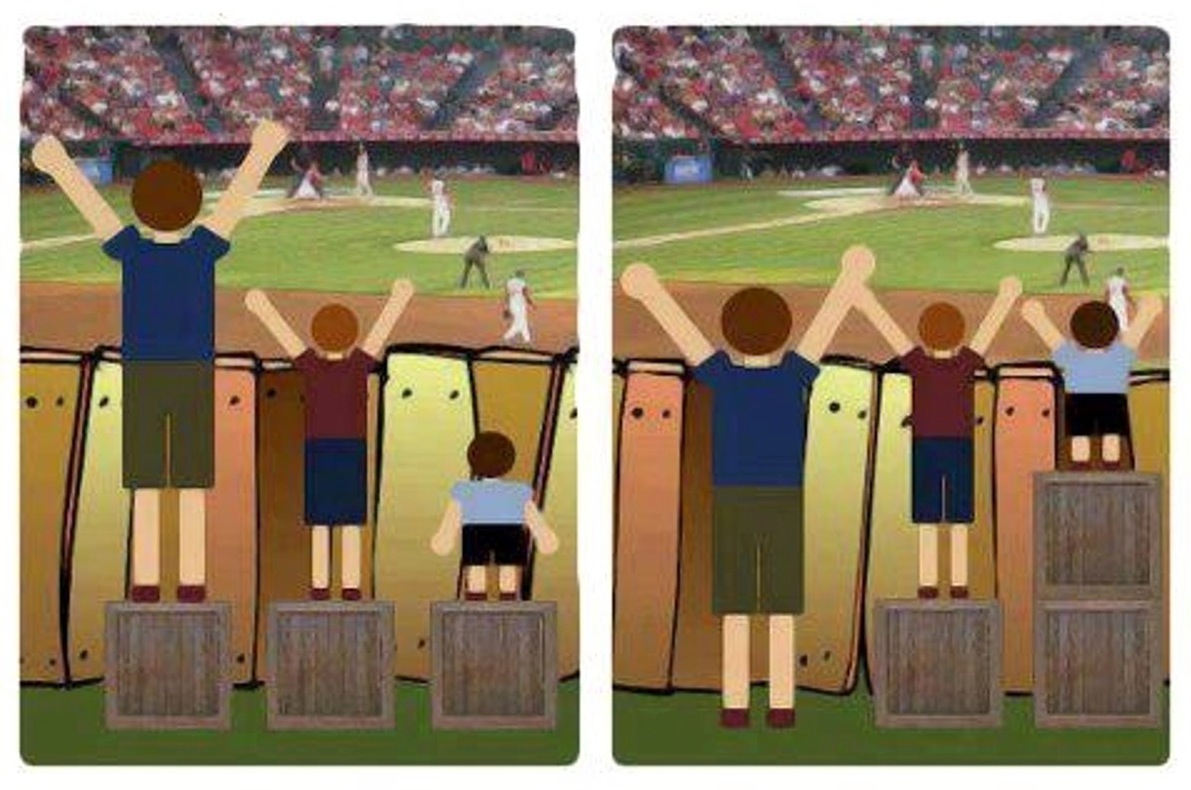
At the annual meeting and exposition of the National Council of Teachers of Mathematics (NCTM), a major theme was the access and equity of high quality mathematics instruction for all students in the United States.  This included race, ethnicity, gender, socioeconomic status, ESL/ELL students and students who were often referred to as “struggling in math.”  Very rarely was the access and equity of high quality mathematics instruction for students with disabilities discussed.

Equity and equality does not look the same for everyone.

Equity and equality does not look the same for everyone

I freely admit that the equity for these other students groups must be a topic of discussion, but so does that same equity for students with disabilities.  Students with all disabilities, not just those who “struggle in math.”  If we are going to advocate for access and equity, then every student should be represented in the discussion.

NCTM’s Principles to Actions: Ensuring Mathematical Success for All describes their vision of access and equity in this way:

Our vision of access and equity requires being responsive to students’ backgrounds, experiences and knowledge when designing, implementing, and assessing the effectiveness of a mathematics program.  Acknowledging and addressing factors that contribute to differential outcomes among groups of students is critical to ensure that all students routinely have opportunities to experience high-quality mathematics instruction, learn challenging mathematics content, and receive the support necessary to be successful.  Our vision of equity and access includes both ensuring that all students attain mathematics proficiency and increasing the numbers of students from all racial, ethnic, gender, and socioeconomic groups who attain the highest levels of mathematics achievement.  (p. 60)

Students with disabilities are clearly lacking from this vision of access and equity.  Why? Students with disabilities are just as much a part of the fabric of our national education system as any other “stakeholders.”  Why have they been carefully left out of the conversation?

Continue reading

Why Count Your Money, When You Can Estimate?

The end of spring break means we are in the midst of our school’s spring financial literacy unit.  This is always a favorite of both students and teachers.  We ground our work in very concrete community related activities, such as going to the bank and going to the store.  Students love spending money and teachers love going on community walks in the spring and early summer. Everyone wins!

Before we start going on trips, I wanted to do some number sense work with my classes relating to the counting of money.  As we left for spring break I tweeted about an estimation idea inspired by counting money.

Right on cue, Graham Fletcher, who writes his own amazing blog here, gave me some sage advice.

I took Graham’s advice and ran with it.  As much as we like our money math standards to relate to identification of coins and bills and getting accurate counts on prices and change, estimation is a key skill in any “real world” financial transaction.  When was the last time you stood at the supermarket register counting out the entire pile of change you got from the cashier? Generally, we look at the coins in our hand and make a quick estimate as to whether we think it is the correct change or not.  So I used the idea from my tweet, took some inspiration from fellow math teachers Andrew Stadel and Joe Schwartz, and turned it all into a financial literacy lesson.

Here’s how it went…

Continue reading

Noticing and Wondering About Scaffolding

Often I wonder how much to explain or define for my students before engaging in the problem solving process.  Proponents of sense-making in mathematics classes like Dan Meyer and The Math Forum encourage presenting a perplexing scenario to students and letting them develop the questions to be answered using math.  This is a very enticing proposition.  Who wouldn’t want a math class which uses the Socratic method to solve problems as a community.  I do!  Professor Ilana Horn recently wrote a piece investigating the merits of this pedagogical philosophy with other popular options like Doug Lemov’s Teach Like a Champion.

Some students, however, need more scaffolding, language support, cultural background, or skill reinforcement before they are ready to grapple with a truly perplexing situation.

Vygotsky's Zone of Proximal Development

Vygotsky’s Zone of Proximal Development

For instance, what if your students view their zone of proximal development much differently than you, as the educator, do?  What if the student views every problem as lying in the outer ring, but it truly lies in the middle or inner ring according to your professional opinion?  Which leads into my question about problem-based learning.  How much do you scaffold for students who need it before you set them free to make sense of a great, perplexing mathematical scenario?

This is a major question for special education math teachers.  How much scaffolding is too much so that the process of solving the problem is taken out of the hands of the student?  One area where this comes up is when teachers are deciding what order in which to present information to students during the problem solving process.  As an example, here is a problem I have been developing in which there are two components.  Which of these components should go first in a truly problem-based classroom?  Maybe you can help me figure it out!

Continue reading