#NYCMathTweetup

This is a re-post from the Global Math Department Newsletter from 12/23/14

What do you get when you mix cautious optimism, nervous excitement, math nerds, pedagogical dreamers, and the internet?

The answer: #NYCMathTweetup.

On Friday, December 12th, a group of #MTBoS and Global Math Department teachers and pedagogues combined their love of math, teaching, twitter, and bite-sized food into what could only be described as “like professional development, except, you know, fun!” (Chris Burke, @mrburkemath).

New Visions for Public Schools, a NYC non-profit organization, which is “dedicated to ensuring that all New York City public school students, regardless of race or economic class, have access to a high-quality education that prepares them for the rigors of college and the workforce,” hosted the shindig.  New Visions staff member and prolific blogger David Wees (@davidwees) was the master of ceremonies and led a rousing game of “Does This Suck?” which included such polarizing topics as homework, regents exams, technology in math class, and grouping students by ability.  You can read more from New Visions and see photos of the event here.

The Global Math Department’s own Carl Oliver also blogged about the event and the after party here.

Continue reading

Number Strings

This is a re-post from the Global Math Department Newsletter from 12/2/14

If you haven’t signed up for the GMD newsletter, please take a minute and do so by clicking the picture.

best_global_math_big_marker_logo.001

I’ll wait…

You’re back and signed up?

Good!

Anyway, number strings are a classroom routine which I believe need to be highlighted more than they are currently. Rachel Lambert, an author of the number strings blog, was my school’s math consultant when I began my career. She has helped to shape who I am as a math teacher and my beliefs of what good math education is.  The following is an article from the GMD newsletter published on 12/2/14:

You may be aware of the Contexts for Learning Mathematics curriculum developed by Cathy Fosnot. A major component of the curriculum is a pedagogical technique designed to introduce and practice computational ideas and strategies called number strings. You may not be as aware of how to utilize this particular technique in your classroom. That’s where Rachel Lambert and Kara Imm’s blog called Number Strings comes to the rescue!

Continue reading

Hi.

One reason it took me so long to start a blog was the belief that my first post had to match some of the great writing debuts.  I hope this belief was misguided, because this won’t be that.  Instead of waxing poetic about my education beliefs, like any good teacher or writer, I’d like to show you instead of telling you.

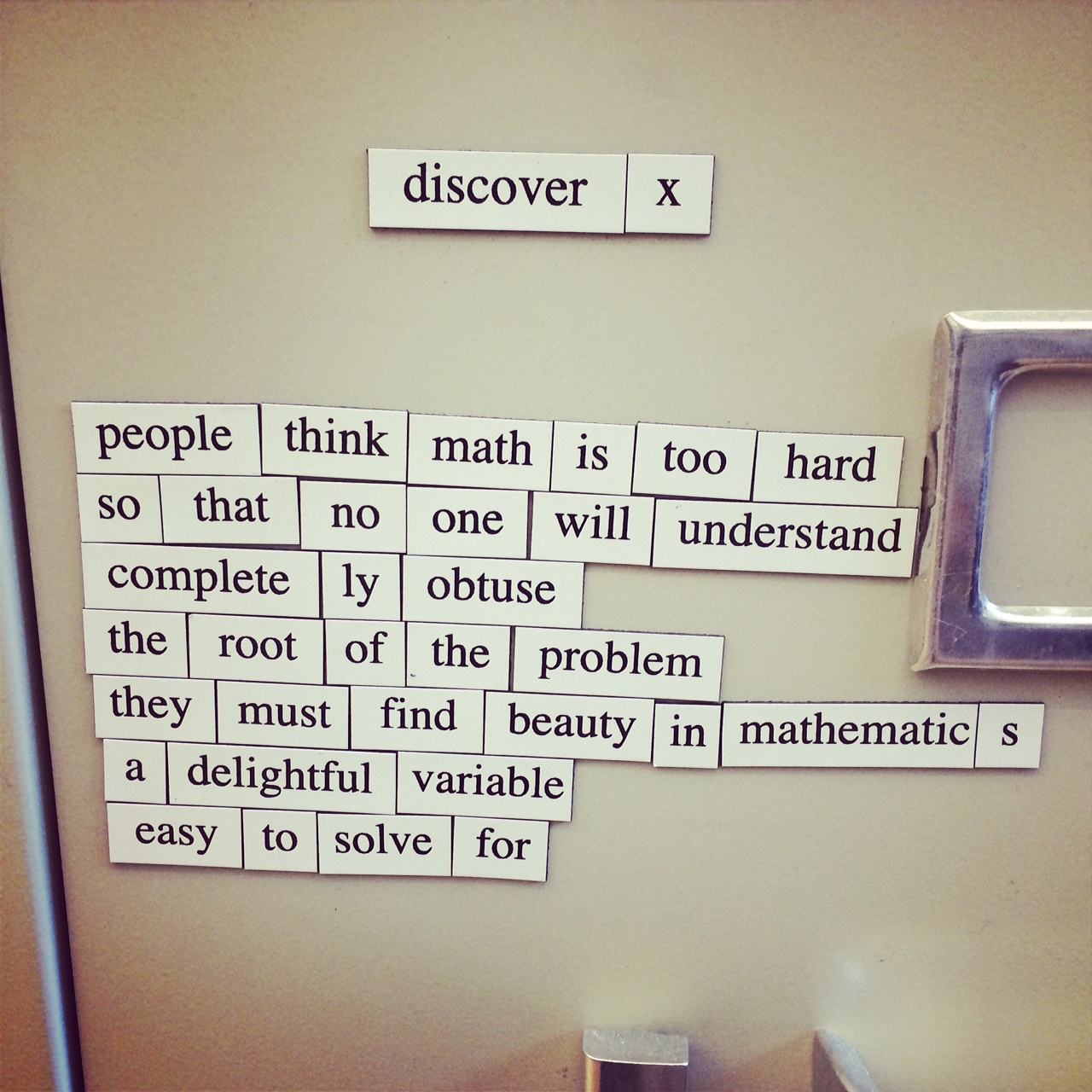
I recently received a magnetic poetry kit from my assistant teacher called “Math Poet.”  Now, I’m not saying I am, but I’m also not saying I’m not.  With the encouragement of fellow math teachers interested in poetry @mathinyourfeet and @simon_gregg, I used the kit to write a poem about math education.

I hope through reading this poem, you’ll be able to infer who I am as a writer and as a teacher.  You’ll also, hopefully, be able to tell what I believe about mathematics, education, writing and magnetism.

IMG_7035

And yes, I am pro-magnetism.