#10goodthings I’ve Learned This Year

First, I read @stoodle’s Exorcising Teacher Demons post.  In his post what stood out to me was that he took the “high road.”  Instead of actually venting for a whole blog post, which could be counter-productive, Matt chose to take his co-worker’s challenge:

If you were asked to come up with 10 things that you’re doing well this year, you could do it.

Then Meg Craig put out the call…

Here is my response to both Matt and Meg, but with a twist.  This year I have learned so much from the twitter/blog community known as #MTBoS (math twitter blogosphere) that I needed to show all of these wonderful educators just how important their impact is for educators across the country.  So, I decided to write 10 good things I’ve learned.
Continue reading

We Made a Math Game!

Well, to be more precise we made a puzzle-y, game-y type thing.

Let me explain.

If you follow me on twitter, then you saw this little bit of nerdiness…

I bought this dice bonanza bucket at Target during Christmas break.  I was very motivated to put the new dice to work for my students!

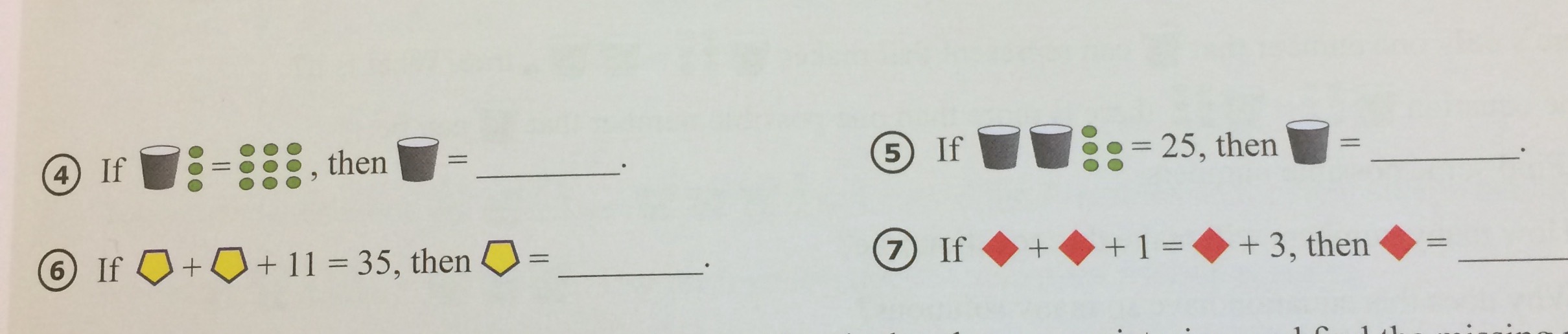
As I wrote about previously, one of my classes is studying algebra.  The contents of the dice bonanza varied between number dice, dot dice, color dice, and others it reminded me of Transition to Algebra like this:

FullSizeRender (3)

So my assistant teacher and I put the dice to work in this puzzle game we called Dice ID.  Here is the instruction booklet and here is the game board.

And here is how it went in our class last Friday…

Continue reading

Quantification

The amazing science podcast, Radiolab, recently did a show titled “Worth.”  Andrew Stadel, over at Divisble by 3, blogged about some math problems this podcast made him think of.  The podcast didn’t necessarily make me think about math problems, instead it made me consider reasoning about value and quantity.  More specifically, is everything quantifiable?

Google defines “quantify” in this way:

Screen Shot 2015-01-08 at 6.17.34 PM

Which makes me wonder can everything be expressed or measured in a quantity?  Can everything be quantified?

Radiolab gives three instances in which things are given a dollar amount that would not normally be thought of in this way.  It gives worth to things that are normally thought of as “priceless.”

Does everything have a price?

Continue reading

Algebra with a capital A!

I teach at a self-contained special education high school in SoHo in NYC.  Our math department does a good job of incorporating “algebraic thinking” into every problem we pose or task we assign.  Though, as they are in high school, our students are aware of what they “should be learning.”  In other words, they see what their peers without disabilities are doing in math class and generally it is not what they are doing.

So the desire to learn Algebra comes up quite frequently.  (The capital A is intentional in this case!)  Algebra is like our student’s white whale.  So, I try to be the boat to their Ahab.

My frustration, however, is that the typical approach to Algebra, with a capital A, is heavily language based. Vocabulary such as variable, dependent, independent, inverse, and substitute are very basic to capital A-lgebra, but they are also complex terms (and ones which have alternate meanings in everyday speech) that our students would require most of the year just committing to memory.

So I have been on a search for capital A-lgebra work that bypasses this vocabulary at least at the very beginning.  Cut to Fawn Nguyen’s Visual Patterns and Heinemann’s Transition to Algebra.

I began with a pre-assessment task about toothpicks

Continue reading

#NYCMathTweetup

This is a re-post from the Global Math Department Newsletter from 12/23/14

What do you get when you mix cautious optimism, nervous excitement, math nerds, pedagogical dreamers, and the internet?

The answer: #NYCMathTweetup.

On Friday, December 12th, a group of #MTBoS and Global Math Department teachers and pedagogues combined their love of math, teaching, twitter, and bite-sized food into what could only be described as “like professional development, except, you know, fun!” (Chris Burke, @mrburkemath).

New Visions for Public Schools, a NYC non-profit organization, which is “dedicated to ensuring that all New York City public school students, regardless of race or economic class, have access to a high-quality education that prepares them for the rigors of college and the workforce,” hosted the shindig.  New Visions staff member and prolific blogger David Wees (@davidwees) was the master of ceremonies and led a rousing game of “Does This Suck?” which included such polarizing topics as homework, regents exams, technology in math class, and grouping students by ability.  You can read more from New Visions and see photos of the event here.

The Global Math Department’s own Carl Oliver also blogged about the event and the after party here.

Continue reading

Number Strings

This is a re-post from the Global Math Department Newsletter from 12/2/14

If you haven’t signed up for the GMD newsletter, please take a minute and do so by clicking the picture.

best_global_math_big_marker_logo.001

I’ll wait…

You’re back and signed up?

Good!

Anyway, number strings are a classroom routine which I believe need to be highlighted more than they are currently. Rachel Lambert, an author of the number strings blog, was my school’s math consultant when I began my career. She has helped to shape who I am as a math teacher and my beliefs of what good math education is.  The following is an article from the GMD newsletter published on 12/2/14:

You may be aware of the Contexts for Learning Mathematics curriculum developed by Cathy Fosnot. A major component of the curriculum is a pedagogical technique designed to introduce and practice computational ideas and strategies called number strings. You may not be as aware of how to utilize this particular technique in your classroom. That’s where Rachel Lambert and Kara Imm’s blog called Number Strings comes to the rescue!

Continue reading

Hi.

One reason it took me so long to start a blog was the belief that my first post had to match some of the great writing debuts.  I hope this belief was misguided, because this won’t be that.  Instead of waxing poetic about my education beliefs, like any good teacher or writer, I’d like to show you instead of telling you.

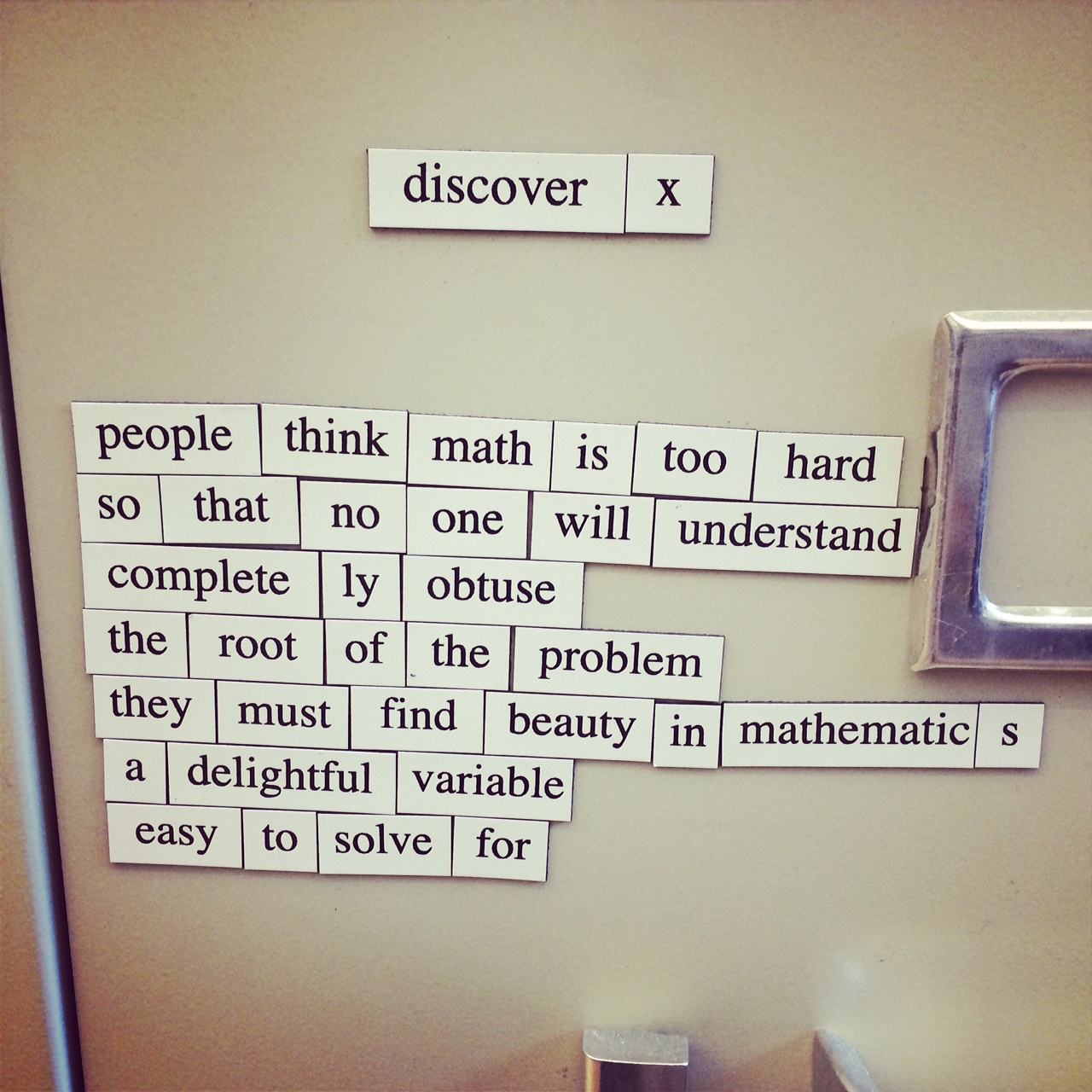
I recently received a magnetic poetry kit from my assistant teacher called “Math Poet.”  Now, I’m not saying I am, but I’m also not saying I’m not.  With the encouragement of fellow math teachers interested in poetry @mathinyourfeet and @simon_gregg, I used the kit to write a poem about math education.

I hope through reading this poem, you’ll be able to infer who I am as a writer and as a teacher.  You’ll also, hopefully, be able to tell what I believe about mathematics, education, writing and magnetism.

IMG_7035

And yes, I am pro-magnetism.